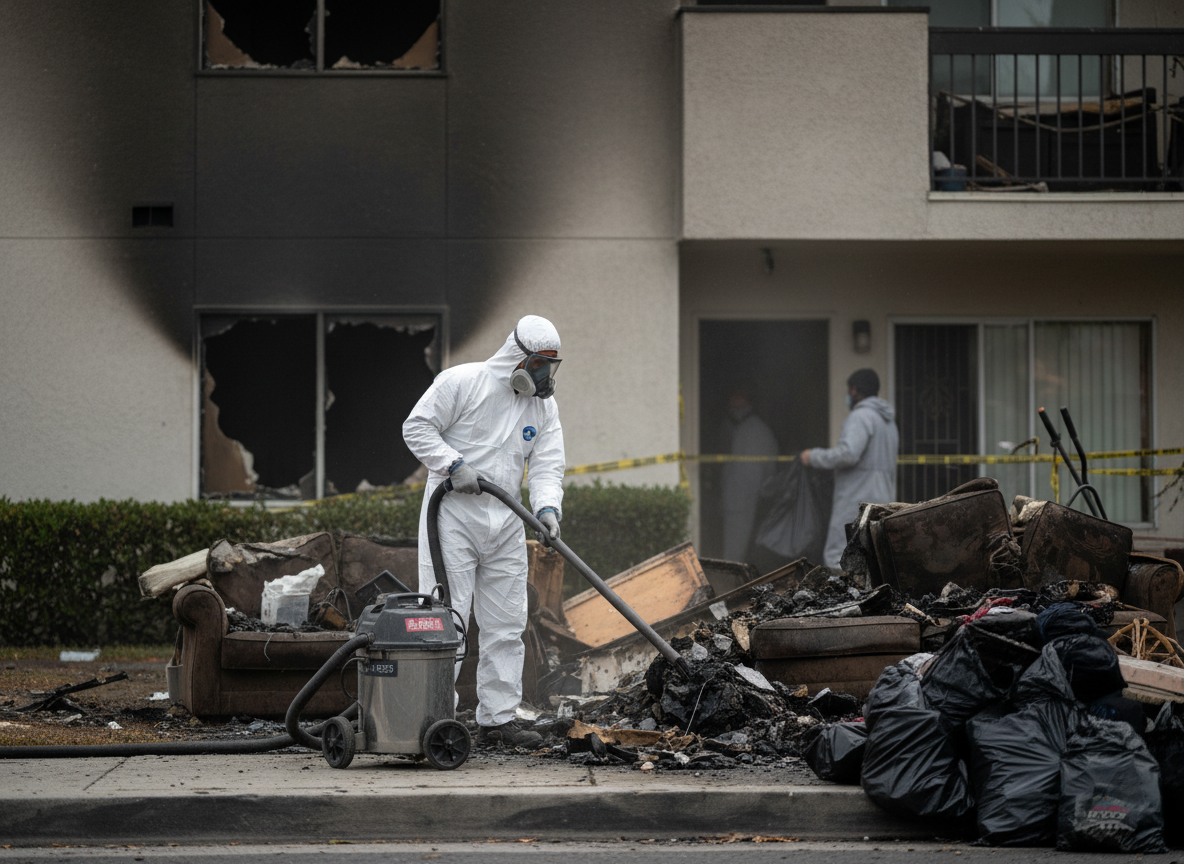
Panorama City apartments built in the 1950s and 1960s often feature shared HVAC runs and lath-and-plaster walls that let smoke travel between units faster than in newer construction. Hot dry summers typical of the San Fernando Valley turn soot into a fine powder that settles deep into carpet pads and behind baseboards near the Sepulveda Basin. Crews must isolate each unit’s ventilation early or residue re-circulates when the system restarts. Older electrical panels in these buildings also require careful protection during wet cleaning to avoid tripping breakers shared with neighboring apartments.
Los Angeles County fire codes mandate documentation of all affected units before any reconstruction begins, especially in buildings within a half-mile of Panorama Mall where occupancy is dense. Technicians map smoke migration through ceiling cavities and party walls using moisture meters and particulate counters rather than relying on visible marks alone. In North Hills and Sylmar complexes the same dry summer air that speeds soot adhesion also dries out wood framing, so crews apply antimicrobial rinses immediately after debris removal to prevent hidden mold growth once humidity returns.
Multi-story buildings along Nordhoff Street frequently have stucco exteriors that trap smoke under the surface layer. Removal requires low-pressure media blasting calibrated to avoid damaging the underlying paper-faced insulation common in 1960s construction. After cleaning, negative-air machines run for several days to pull remaining particulates out through windows facing Van Nuys Boulevard before final clearance testing.
Technician insight
In Panorama City the thing that catches most people out with Apartment fire cleanup is how quickly smoke moves through the shared laundry chutes and bathroom exhausts in 1960s buildings near the Panorama City Branch Library, especially when summer heat keeps every window shut for weeks.
Kitchen fire smoke spread in Van Nuys complex
Smoke from a second-floor kitchen fire traveled through a common vent shaft into three lower units. We found heavy soot inside the shared HVAC trunk and behind kitchen cabinets. Containment barriers and negative air machines stopped further migration while we cleaned ducts and surfaces. Units passed clearance testing and tenants returned within five days.
How it works
- 1
Initial Assessment
Technicians inspect all affected units and shared systems to map smoke travel through vents and walls.
- 2
Containment Setup
Plastic barriers and negative pressure isolate each apartment to stop cross-contamination during cleaning.
- 3
Soot and Residue Removal
Specialized equipment extracts embedded particles from porous materials and HVAC components.
- 4
Final Clearance
Air quality testing and visual inspection confirm safe re-occupancy before reconstruction begins.
Pricing
Pricing varies with the number of units affected and the depth of smoke migration through shared systems.