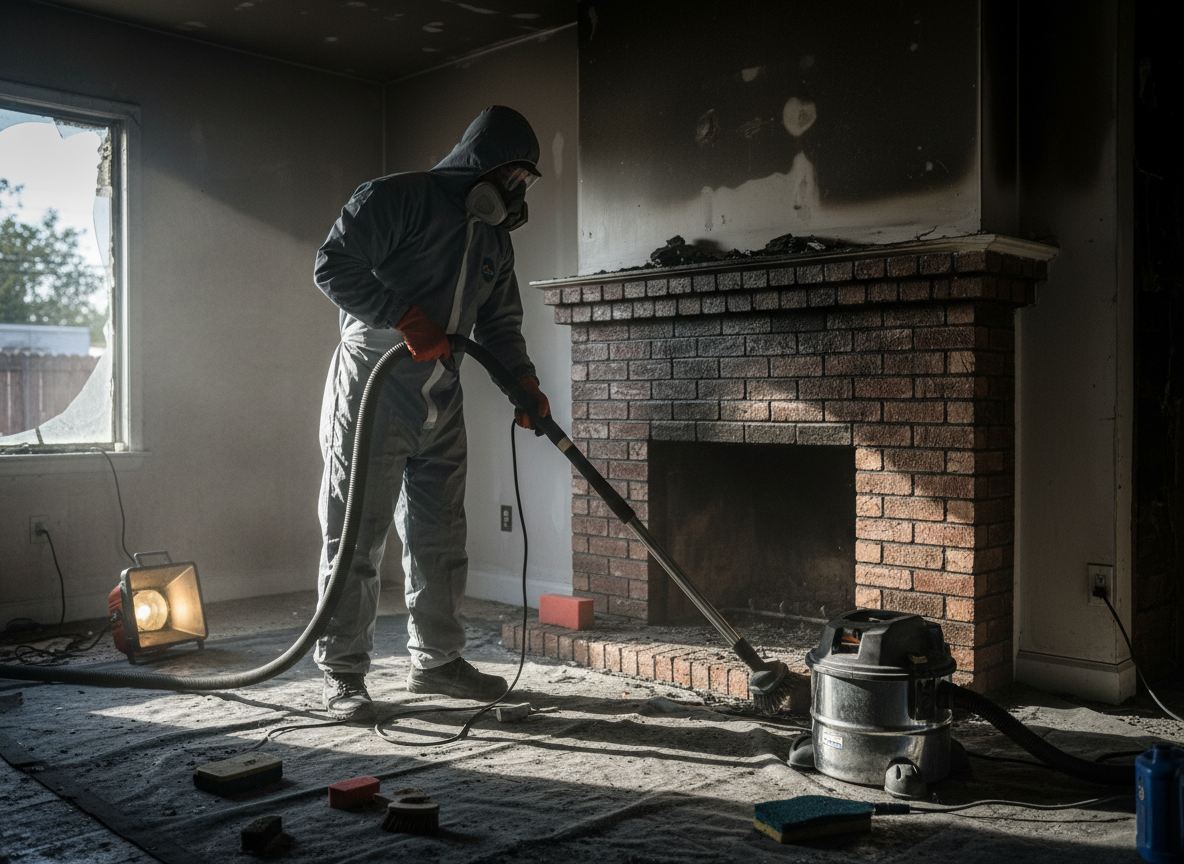
Soot from structure fires in Panorama City often bonds to older stucco exteriors and plaster walls common in homes built near the Sepulveda Basin and Panorama Mall. The area's Mediterranean climate with hot, dry summers accelerates particle adhesion on porous surfaces while low humidity keeps fine residues airborne longer during cleanup. Technicians must use HEPA filtration and negative air machines to prevent cross-contamination into unaffected rooms, especially in multi-unit buildings along Nordhoff Street where shared ventilation spreads particles quickly between units in Van Nuys and North Hills.
Edge cases arise when soot mixes with water used during suppression, creating acidic residues that etch metal fixtures and discolor concrete slabs typical of 1950s-1970s housing stock in Sylmar and North Hills. Standard TSP substitutes fail on these surfaces; pH-neutral agents and multiple passes with specialized sponges are required instead. Los Angeles County air quality rules also limit certain solvent use outdoors during summer months, forcing crews to adjust dwell times and rely more on mechanical removal methods to stay compliant without leaving visible film.
Homeowners often overlook soot inside HVAC returns and behind baseboards after small kitchen fires, allowing odors to return once dry weather resumes. Proper verification includes swab testing on multiple surface types rather than visual inspection alone. Work near the Panorama City Branch Library or commercial strips demands dust containment barriers that account for foot traffic and wind patterns funneled through the basin terrain.
Materials matter: latex paint on drywall in Van Nuys tract homes releases soot differently than oil-based finishes in older North Hills properties, requiring distinct agitation techniques to avoid ghosting. Crews document every step with photos because insurance adjusters frequently question whether residues originated from the reported fire or prior cooking events common in the neighborhood.
Technician insight
In Panorama City, the thing that catches most people out with Soot removal is how the hot dry summers drive fine particles deep into the unsealed stucco and attic insulation of homes near Sepulveda Basin, so a quick wipe leaves odors that return the first time the AC kicks on.
Kitchen Soot After Electrical Fire Near Nordhoff
Problem: Soot coated cabinets and entered HVAC after a wiring fire in a 1960s Panorama City home. What we found: Particles had traveled through shared ducts into two bedrooms and settled on older plaster walls. What we did: Set containment, cleaned ducts and surfaces with pH-neutral methods, then verified with swabs. Outcome: Odors eliminated and home cleared for reoccupancy without further issues.
How it works
- 1
Initial Assessment
Inspect all affected rooms, HVAC systems, and hidden cavities using moisture meters and borescopes to map soot migration in Panorama City homes.
- 2
Containment Setup
Install plastic barriers and negative air units to isolate work zones, protecting adjacent areas from cross-contamination during dry summer conditions.
- 3
Surface Cleaning
Apply appropriate agents and HEPA vacuuming to walls, ceilings, and contents while monitoring for residue on stucco and older drywall.
- 4
HVAC and Detail Work
Clean ducts, registers, and behind fixtures, followed by odor neutralization and final swab verification before reassembly.
- 5
Final Clearance
Walk-through with property owner and photo documentation to confirm removal across all targeted surfaces.
Pricing
Pricing varies with the square footage affected, surface types, and whether HVAC cleaning is required.