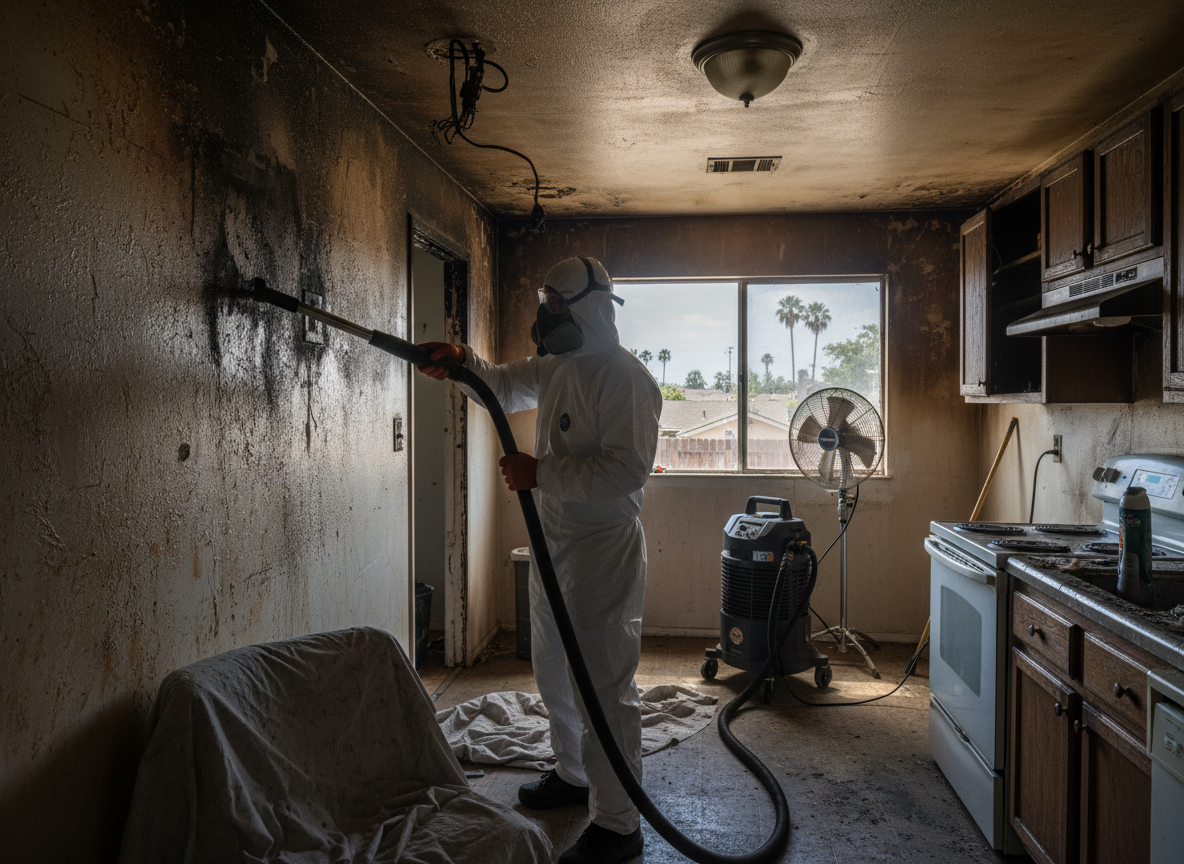
Smoke from structure fires in Panorama City often penetrates older single-family homes and apartments built before modern sealing standards, leaving residues on drywall, insulation, and HVAC systems common in Los Angeles County housing stock. Hot, dry summers accelerate smoke particle adhesion to surfaces around the Sepulveda Basin, requiring technicians to address both visible soot and invisible acidic residues that can corrode metal fixtures and electronics if not neutralized promptly. Work near the Panorama Mall or along Nordhoff Street frequently involves multi-unit buildings where shared ventilation spreads odors between units, demanding containment barriers and negative air machines before any cleaning begins.
Restoration crews must account for the porous stucco and wood framing prevalent in North Hills and Van Nuys neighborhoods, where smoke travels through wall cavities more readily than in newer sealed construction. Mediterranean climate conditions mean low humidity periods allow odors to linger longer, so thermal fogging and hydroxyl generators are often deployed after initial HEPA vacuuming to break down volatile organic compounds. Technicians also check for hidden moisture from suppression efforts, as water left in attics or under flooring near the Panorama City Branch Library area can lead to secondary mold growth within days.
Code considerations in Los Angeles County require proper disposal of contaminated materials and documentation of air quality testing before reoccupancy, especially in properties close to Sylmar where wind patterns can carry smoke farther. Edge cases include electronics and fabric furnishings that absorb odors deeply, often needing off-site ozone treatment rather than in-place cleaning. Homeowners sometimes overlook ductwork cleaning, allowing smoke to recirculate after the job appears complete.
Technician insight
In Panorama City, the thing that catches most people out with smoke damage restoration is how the dry summer winds push smoke into wall cavities of 1950s-1970s homes near the Sepulveda Basin, so surface cleaning alone never solves the odor until you open those spaces.
Smoke Infiltration After Kitchen Fire
A single-family home off Nordhoff Street had smoke travel through the HVAC after a cooking fire. Inspection revealed residue inside ducts and behind baseboards in multiple rooms. Crews contained the space, cleaned ducts, and treated cavities with neutralizers before clearance testing.
How it works
- 1
24/7 Emergency Assessment
Technicians arrive from the Nordhoff Street location to document smoke patterns, test air quality, and identify affected materials in Panorama City homes.
- 2
Containment And Source Removal
Barriers and negative pressure setups prevent cross-contamination while removing charred debris and loose soot from Van Nuys and North Hills properties.
- 3
Deep Cleaning And Odor Neutralization
Specialized agents and equipment treat porous surfaces and HVAC systems common in the area's older housing stock.
- 4
Final Verification And Clearance
Air sampling and visual inspection confirm residues are removed before returning the property to owners.
Pricing
Pricing depends on square footage affected, depth of smoke penetration into cavities, and whether contents require off-site treatment.