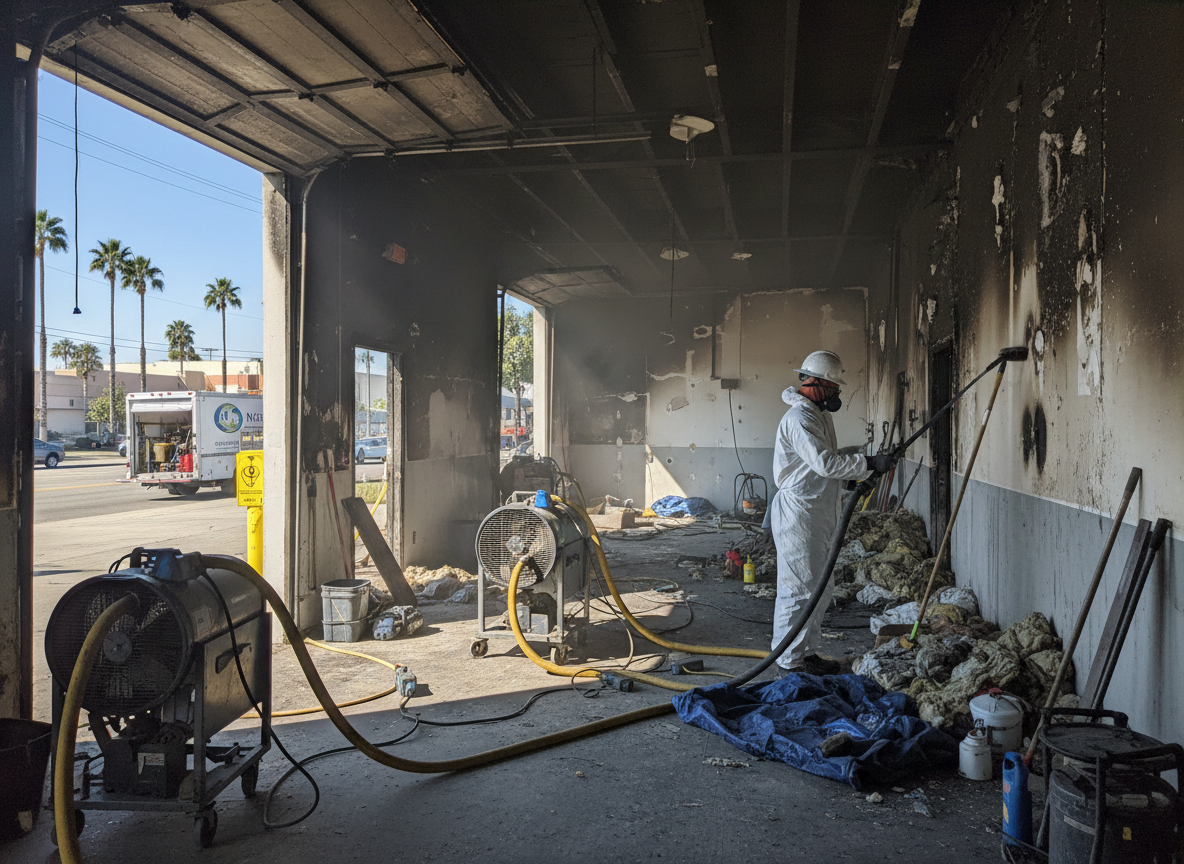
Commercial buildings in Panorama City often feature older HVAC systems and suspended ceilings that trap smoke and soot after a fire. Mediterranean climate summers with low humidity and hot winds can allow embers to travel farther, especially near the Sepulveda Basin where open terrain meets retail and light-industrial zones. Restoration crews must isolate these systems quickly to prevent cross-contamination into adjacent tenant spaces around Panorama Mall and the Panorama City Branch Library area.
Los Angeles County fire codes require documentation of all affected materials before demolition or cleaning begins. In North Hills and Van Nuys commercial strips, many structures built before 1980 contain asbestos-containing floor tiles and insulation that become friable during fire events. Technicians test and contain these materials on site rather than relying on general removal practices used in newer construction.
Water used during suppression frequently pools in slab-on-grade floors common to Panorama City warehouses and strip centers. Residual moisture combined with summer heat accelerates mold growth beneath vinyl composition tile and carpet. Drying plans must account for the county's variable soil conditions and limited drainage around Nordhoff Street corridors to avoid secondary damage claims.
Electrical and data cabling runs in older commercial ceilings often sustain hidden heat damage that only appears after power is restored. Crews perform phased re-energization checks while coordinating with local utility providers serving Sylmar and Van Nuys to prevent repeated outages for neighboring businesses.
Technician insight
In Panorama City the thing that catches most people out with Commercial fire restoration is how quickly smoke travels through the shared attic spaces and single-layer roof decks on 1960s strip centers along Nordhoff Street when hot dry summer winds pick up.
Retail Unit Fire Near Panorama Mall
An electrical fire started in the back office of a clothing store in a 1970s strip center. We found soot had traveled through the common drop ceiling into three neighboring units and moisture had wicked into the slab from suppression water. We isolated the HVAC, performed county-mandated testing, dried the concrete, and cleared the space for rebuild within nine days.
How it works
- 1
Emergency Assessment
Technicians arrive within hours to document fire and smoke patterns, test for asbestos in pre-1980 buildings, and secure the site against further weather intrusion common in dry summer months.
- 2
Containment and Air Scrubbing
Negative air machines and physical barriers isolate affected zones to keep soot from migrating into shared corridors or adjacent retail spaces near Panorama Mall.
- 3
Debris Removal and Material Testing
Los Angeles County-compliant removal of charred fixtures and testing of remaining structural elements precedes any cleaning to satisfy local permit requirements.
- 4
Structural Drying and Odor Neutralization
Industrial dehumidifiers and hydroxyl generators address moisture trapped in slabs while removing smoke odors that linger in older ventilation systems.
- 5
Final Clearance and Rebuild Coordination
Independent testing confirms air quality before turning the space back to the tenant and coordinating with licensed contractors for code-compliant repairs.
Pricing
Upfront quotes based on square footage, smoke migration depth, and required testing for older commercial stock; no hidden fees for after-hours response.