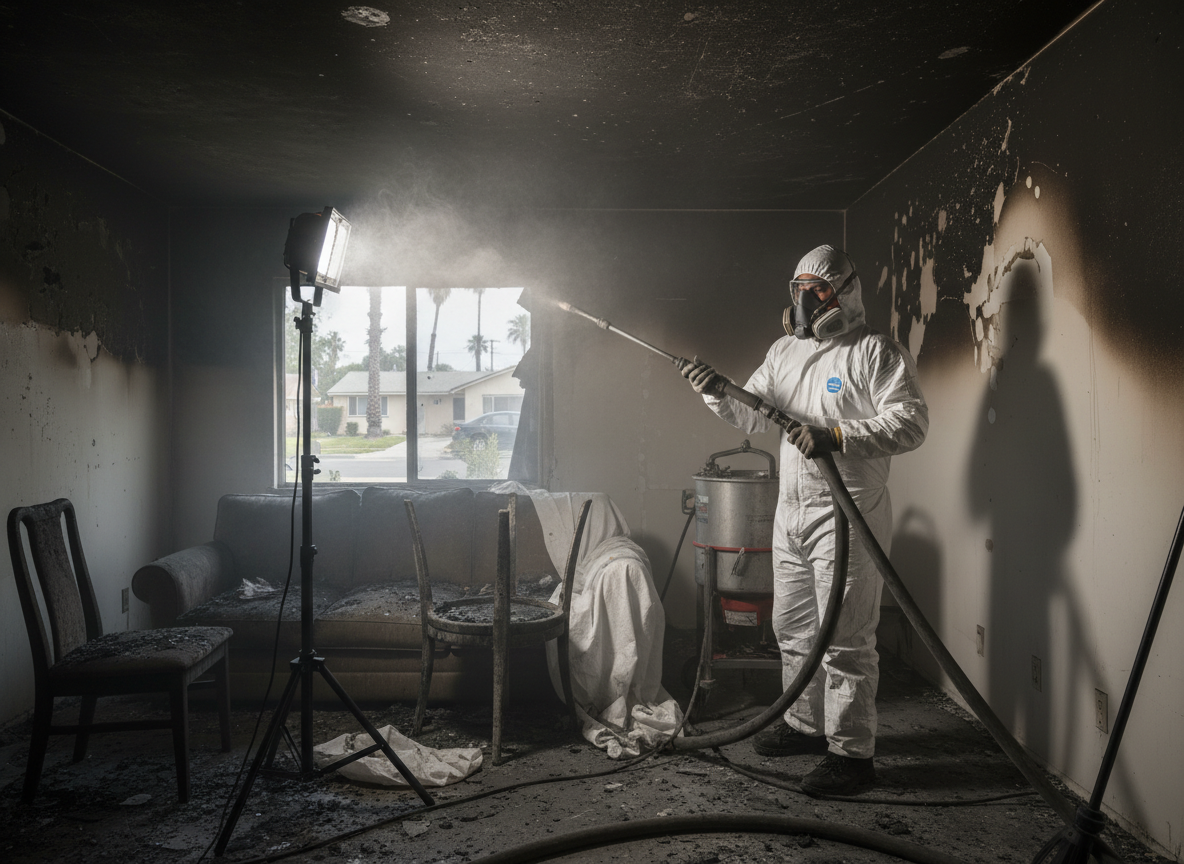
Smoke remediation in Panorama City requires understanding how Mediterranean climate patterns with prolonged hot dry summers allow fine soot particles to migrate deep into porous materials like drywall, stucco, and attic insulation common in post-war homes throughout the neighborhood. Technicians must account for the way prevailing winds carry smoke from regional fires into structures near the Sepulveda Basin, where older ventilation systems and single-story layouts create hidden pockets that standard cleaning misses. Failing to map these paths before treatment often leaves residual odors that return when humidity rises in late fall.
Los Angeles County building practices in Van Nuys and North Hills frequently include textured ceilings and layered flooring that trap smoke between surfaces, demanding sequential HEPA vacuuming, chemical neutralization, and thermal fogging rather than surface wiping alone. Crews working from the Nordhoff Street base routinely test pH levels on concrete slabs because alkaline residues from certain smoke types react with local soil minerals and re-emit odors weeks later. Homeowners who attempt DIY ozone machines without addressing these layers typically void any future professional warranty on the same surfaces.
Edge cases appear when smoke travels through shared walls in duplexes near Panorama Mall, requiring coordination with adjacent units to prevent cross-contamination. Technicians document every affected register and chase because forced-air systems in these homes recirculate particles long after the fire is out. Proper documentation also satisfies Los Angeles County permitting notes when structural repairs follow remediation.
Technician insight
In Panorama City, the thing that catches most people out with smoke remediation is how the hot dry summers let fine soot travel through the unsealed stucco and attic spaces common in homes built near the Sepulveda Basin, then reappear when fall humidity arrives.
Smoke in North Hills duplex after distant wildfire
Smoke entered through shared attic vents and settled into textured ceilings and carpet padding. Inspection revealed alkaline residues on the concrete slab that standard cleaners would not neutralize. Sequential vacuuming, pH-adjusted washing, and targeted fogging cleared the odor without disturbing neighboring units.
How it works
- 1
Initial Assessment
Inspect all affected rooms, attics, and HVAC runs while noting construction type and smoke travel paths typical in Panorama City homes.
- 2
Containment Setup
Isolate zones with plastic barriers and negative air machines to prevent soot migration into unaffected areas during dry summer conditions.
- 3
Soot Removal
HEPA vacuum and wipe surfaces, followed by pH-adjusted cleaning agents matched to residue chemistry found in Los Angeles County fires.
- 4
Odor Neutralization
Apply thermal fogging or hydroxyl treatment to reach embedded particles in insulation and subflooring.
- 5
Final Clearance
Test air quality and surfaces, then document results for the homeowner before releasing the property.
Pricing
Upfront quotes after on-site inspection; final cost depends on smoke penetration depth, number of affected rooms, and whether HVAC cleaning is required.